For many OEM engineers, the default approach to drawing a custom magnetic assembly is to apply standard metal-machining tolerances (e.g., ±0.01mm or ±0.005mm) to the Neodymium (NdFeB) magnet components.
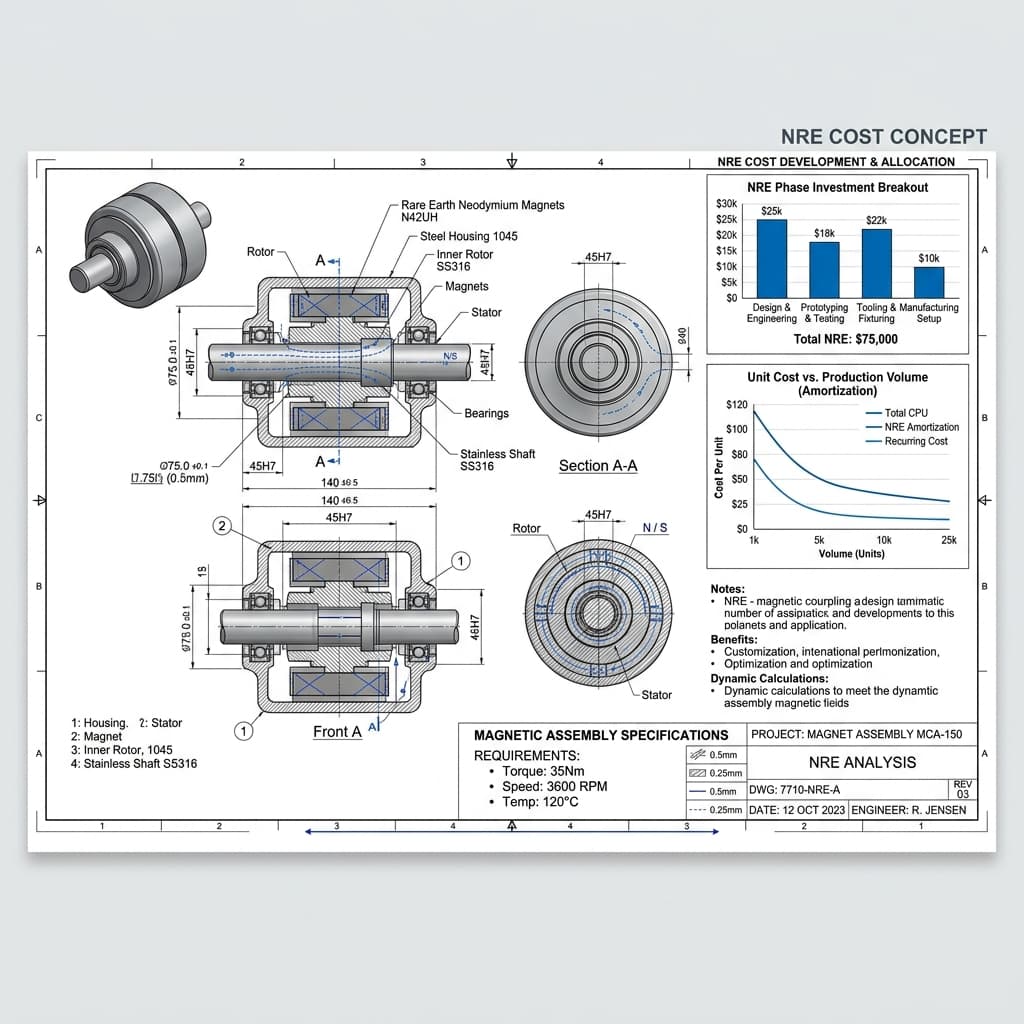
However, NdFeB is not steel. It is a sintered, highly brittle ceramic metallic compound. Applying standard ISO 2768-m (or tighter) tolerances to NdFeB without a critical functional requirement is the single fastest way to skyrocket your unit CPU (Cost Per Unit) and NRE (Non-Recurring Engineering) tooling costs.
This guide breaks down exactly why tight tolerances destroy yield rates and how procurement and engineering teams can optimize Design for Manufacturability (DFM) without sacrificing performance.
1. The NdFeB Machining Process (And Where Yield Dies)
Unlike steel, which can be CNC turned or milled to exact dimensions with a single tool, NdFeB must be sliced, ground, and wire-cut using diamond tooling. Every additional machining step introduces a risk of chipping, micro-cracking, and material loss.
graph TD
    A[Raw Sintered Block] --> B[Multi-Wire Slicing]
    B --> C{Tolerance Required?}
    C -->|Standard +/-0.1mm| D[Centerless Grinding]
    C -->|Tight +/-0.05mm| E[Precision Surface Grinding]
    C -->|Ultra-Tight +/-0.02mm| F[Slow Wire EDM Cutting]
    D --> G[Coating & Plating]
    E --> G
    F --> G
    G --> H[Final Inspection]

    style F fill:#ffebee,stroke:#c62828,stroke-width:2px
    style A fill:#e3f2fd,stroke:#1565c0,stroke-width:2px
When you demand a ±0.02mm tolerance on a complex geometric magnet, the factory is forced to abandon high-speed slicing and move to slow Wire EDM cutting, immediately tripling the machining time and halving the production capacity.
2. The Cost Multiplier Matrix
How much does a tight tolerance actually cost? Our production data across thousands of OEM projects reveals an exponential cost curve.
| Tolerance Band | Typical Application | Manufacturing Impact | Yield Impact |
|---|---|---|---|
| ±0.10 mm | General holding assemblies, standard latches | High-speed multi-wire slicing. Standard barrel plating. | High (>95%) |
| ±0.05 mm | Motor rotors, sensor assemblies | Requires secondary centerless or flat grinding. | Moderate (~85-90%) |
| ±0.02 mm | Precision medical devices, aerospace | Requires slow Wire EDM or specialized precision grinding. Hand-sorting often required. | Low (~60-70%) |
| ±0.01 mm | Advanced optical sensors (Rare) | Requires environmental temperature control during machining and measuring. Extreme risk of chipping. | Critical (<50%) |
3. The "Stack-Up" Fallacy in Magnetic Assemblies
Engineers often specify a ±0.02mm tolerance on the magnet because they are concerned about the total assembly stack-up tolerance (e.g., when press-fitting a magnet into a steel housing or an aluminum rotor).
The DFM Solution: Do not put the tight tolerance on the brittle magnet. Put the tight tolerance on the metal housing.
Steel and aluminum can be CNC machined to ±0.01mm quickly and cheaply. If you need a tight fit, specify the housing slot to a tight tolerance, leave the magnet at a standard ±0.05mm, and use an industrial structural adhesive (like Loctite) to compensate for the gap. This approach drastically reduces the total magnetic assembly cost while maintaining mechanical integrity.
4. Coatings Complicate Tolerances
When specifying tolerances, you must explicitly state whether the dimensions are pre-coating or post-coating.
A standard Ni-Cu-Ni (Nickel-Copper-Nickel) electroplating layer adds approximately 10-15 µm (0.010 - 0.015mm) per surface. If you specify a post-coating tolerance of ±0.02mm, the factory must control the raw magnet grinding to an even tighter band (e.g., ±0.01mm) to account for the natural variance in the electroplating bath.
Pro Tip: For assemblies requiring extreme environmental protection (e.g., salt spray resistance), consider using an overmolded plastic encapsulation or a sealed stainless steel housing instead of demanding heavy epoxy plating on a tightly toleranced magnet.
5. How to Communicate with Your Manufacturer
When submitting an RFQ (Request for Quote) to Magnet Assembly, don't just send a drawing with generic title-block tolerances.
Include a note identifying the Critical to Function (CTF) dimensions. For example:
- O.D. is critical for press-fit (±0.03mm).
- Length is non-critical (±0.10mm is acceptable).
By giving our engineers the freedom to relax tolerances on non-mating surfaces, we can immediately optimize the manufacturing routing, reduce tooling costs, and provide a much more competitive NRE and unit price.
6. Advanced Deep Dive: Cpk vs. Tolerance on Sintered NdFeB
A common blind spot is equating a stated tolerance with a Cpk > 1.33. For sintered NdFeB, achieving a true Cpk of 1.33 on a ±0.02mm tolerance requires continuous dressing of the diamond grinding wheel and thermostatic coolant control.
Case Study: High-Speed Rotor Assembly
- Initial RFQ: Magnet OD 15.00mm ±0.01mm. Supplier quoted $4.50/unit. Yield was 45% due to chipping on the leading edge during centerless grinding.
- DFM Intervention: We moved the critical alignment to the rotor ID (machined steel) and relaxed the magnet OD to ±0.05mm. We introduced a customized assembly fixture to center the magnet during adhesive cure.
- Result: Unit price dropped to $1.80. Cpk on the final assembly runout improved from 0.9 (unstable) to 1.65 (six-sigma level). Total NRE for the fixture was $1,200, paying for itself in the first 500 units.
For a comprehensive review of your current drawing and a free DFM analysis, contact our engineering team at [email protected].