Many programs say "prototype passed" and still miss launch. The gap is usually not magnet physics; it is poor transfer control between engineering validation and production readiness.
Below is a shared stage-gate model with measurable exit criteria and commercial checkpoints that can be used by both buyers and engineering teams.
1. Stage-gate map (what must be true before moving on)
| Stage | Main Goal | Minimum Exit Criteria | Primary Owner |
|---|---|---|---|
| S0: RFQ feasibility | Align technical/commercial assumptions | RFQ package complete, assumptions signed, top-5 risks listed | Buyer + Design engineer |
| S1: Engineering prototype (EVT) | Validate core function | Functional target achieved on pilot samples, failure list opened | Design + Supplier engineering |
| S2: Design validation (DVT) | Validate robustness across tolerance and environment | Reliability pass rate and dimensional capability accepted | Quality + Design |
| S3: Process validation (PVT) | Prove line repeatability and control | Process window locked, Cp/Cpk evidence provided, packaging validated | Supplier operations + Quality |
| S4: Mass production release | Freeze controlled volume launch | Approved control plan, change control in force, shipment criteria agreed | Buyer quality + Supplier quality |
Do not skip gates. "Soft pass" is the biggest source of hidden delay.
2. S0 RFQ feasibility: prevent quote ambiguity early
Before any sample is built, confirm these baseline inputs:
- Application function (holding, sensing, actuation, coupling)
- Functional target and test condition (fixture, air gap, temperature)
- Continuous and peak thermal profile
- Corrosion/media exposure (humidity, salt, fluid, chemical)
- Mechanical interface (critical datums + tolerance intent)
- Annual volume forecast and ramp shape
Commercial lines to lock at S0:
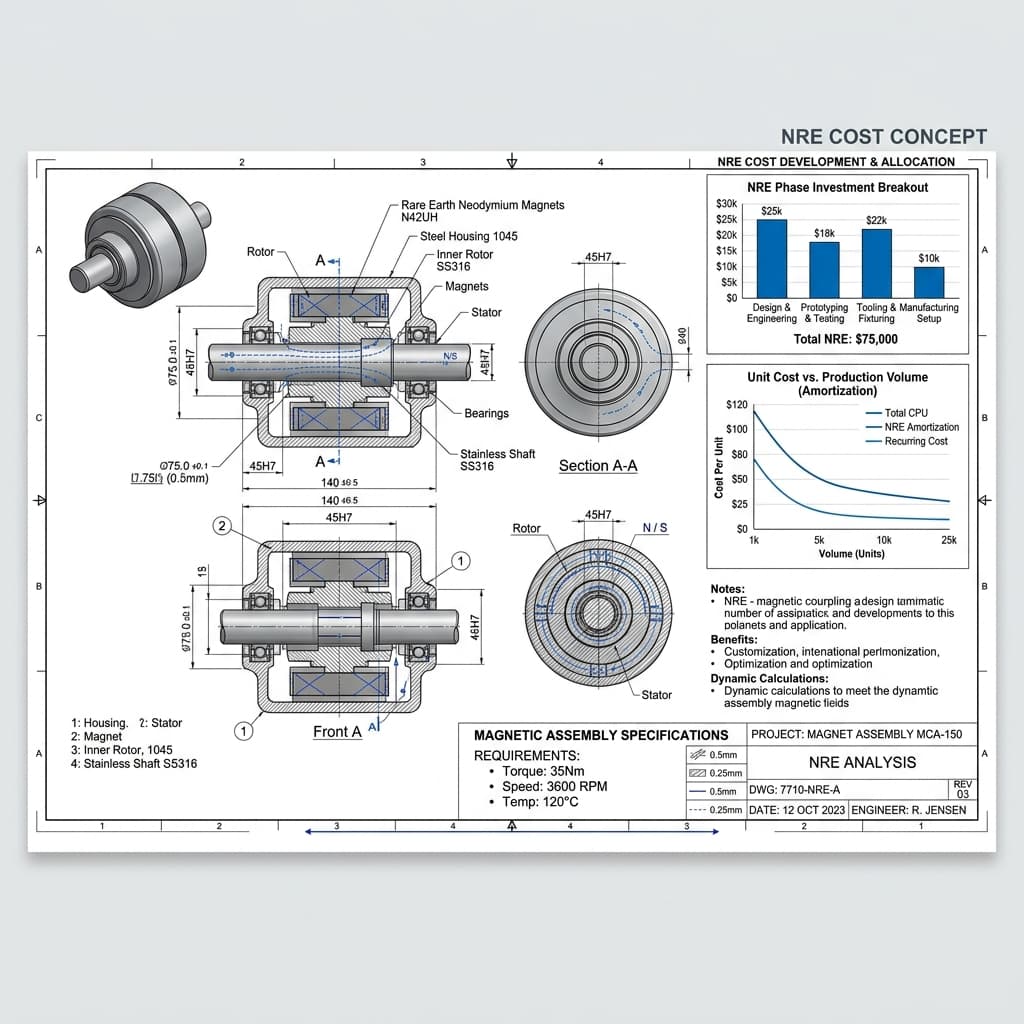
- NRE scope (tooling, fixtures, test setup, validation labor)
- Prototype quantity and lead-time expectation
- Incoterm and destination
- Engineering change handling after prototype approval
If these are missing, suppliers quote different assumptions and your "best price" comparison becomes invalid.
3. S1 EVT: prove function, not production speed
EVT output should answer one question: does this architecture work?
Recommended EVT package:
- Sample lot map (what changed between build lots)
- Functional test report under intended operating condition
- Known-failure list with owner and due date
- Initial DFM notes (adhesive path, press-fit risk, handling risk)
Typical EVT mistakes:
- Accepting room-temperature-only pass for a hot application
- Using hand-build fixtures and treating results as process-capable
- Closing only "critical" issues while leaving repeatability unknown
EVT exit criteria should be binary:
- Functional target reached with repeatable method
- No unresolved blocker-level failure mode
- DVT plan agreed (sample size, stress profile, pass rules)
4. S2 DVT: stress the design and define margins
DVT is where many magnet assemblies fail for the first time. That is healthy if failures are captured before launch.
Minimum DVT coverage:
- Thermal exposure (continuous and peak profile)
- Corrosion/humidity exposure where relevant
- Mechanical durability (vibration, shock, handling)
- Dimensional capability on critical features
- Magnet performance drift before/after stress
Use explicit pass criteria, for example:
- Pull-force window still inside specification after aging
- No crack/chip/coating delamination beyond agreed defect limit
- Critical dimensions within tolerance with measurable process capability
DVT review should close with a "go / fix / re-test" decision, not a presentation-only signoff.
5. S3 PVT: validate the manufacturing system
PVT confirms the process can deliver stable output, not just good samples.
Required PVT artifacts:
- Process flow and PFMEA linked to control points
- Control plan with sampling frequency and reaction plan
- Parameter windows for adhesive cure, press force, magnetization, alignment
- Gauge method for force/flux and dimensional checks
- Pilot lot yield data by failure category
Recommended acceptance metrics (set by project requirement):
- Stable pilot yield trend
- Cpk evidence on key CTQ dimensions
- Containment and corrective loop for top defect modes
- Packaging/transport check with no functional damage
If process windows are not locked, volume ramp will convert engineering noise into customer-visible defects.
6. S4 mass production release: freeze what matters
Before production release, align final controls across teams:
- First-article approval package and master sample
- Shipment release checklist
- Batch traceability fields (lot, material, process, test)
- Change-control triggers and requalification rules
- Escalation path and response SLA for non-conformance
Critical rule: after S4 release, material or process substitutions must not occur silently.
7. Buyer dashboard: 8 signals to monitor every week
Track these program indicators during ramp:
- Open high-risk issues count and aging
- Pilot yield trend by defect mode
- On-time closure rate for corrective actions
- Incoming lot rejection rate
- Functional drift trend after reliability testing
- Quote vs actual lead-time deviation
- Forecast adherence (buyer side)
- Change-request frequency after gate freeze
A simple weekly dashboard catches launch risks earlier than monthly summary calls.
8. Common schedule slips and how to prevent them
| Slip Pattern | Root Cause | Prevention Action |
|---|---|---|
| Prototype pass, pilot fail | Process window never defined | Lock critical parameters in S3 before volume order |
| Repeated quote revision | RFQ assumptions incomplete | Use mandatory RFQ checklist at S0 |
| Field corrosion issue | Coating validated in lab only | Add packaging + transport + storage exposure checks |
| Late tooling rework | Tolerance stack not reviewed early | Run datum and assembly stack review before EVT build |
| Launch delay from ECN churn | Design freeze too late | Define freeze date and post-freeze change gate |
9. Handoff checklist for buyers
Before issuing pilot or mass production PO, confirm:
- Stage exit criteria are documented, not verbal
- Open issues have owner, target date, and containment
- Control plan and reaction plan are signed
- NRE and production commercial terms are aligned
- Change-control and requalification triggers are explicit
Programs that enforce these checks see fewer ramp surprises than programs that only chase faster sample dates.
10. Advanced Deep Dive: The Hidden Cost of "Soft Pass" in PVT
The most dangerous phrase in a magnetic assembly ramp is "we can fix the yield in mass production."
Case Study: Medical Actuator Assembly Ramp
- The Mistake: During PVT (Process Validation Testing), the yield on a critical press-fit operation was 72%. The buyer signed the PVT release to meet a launch deadline, assuming the factory would "sort the bad ones out."
- The Consequence: At a volume of 10,000 units/week, 28% scrap meant 2,800 destroyed NdFeB magnets per week. The factory's cost doubled, lead times slipped by 4 weeks due to material shortages, and the supplier demanded an immediate price increase.
- The Correction: We paused the line and implemented a $4,500 pneumatic servo-press with continuous force-displacement monitoring. We found that variations in the nickel plating thickness (±12µm) were causing interference spikes. By sorting the magnets into two tolerance bins before insertion, yield immediately jumped to 99.4%.
- Takeaway: Never exit PVT without a Cp/Cpk > 1.33 on critical mechanical and magnetic parameters. Sorting is not process control.
For a quick feasibility and gate review, send your package to [email protected] or WhatsApp +8618857971991 (Open WhatsApp).