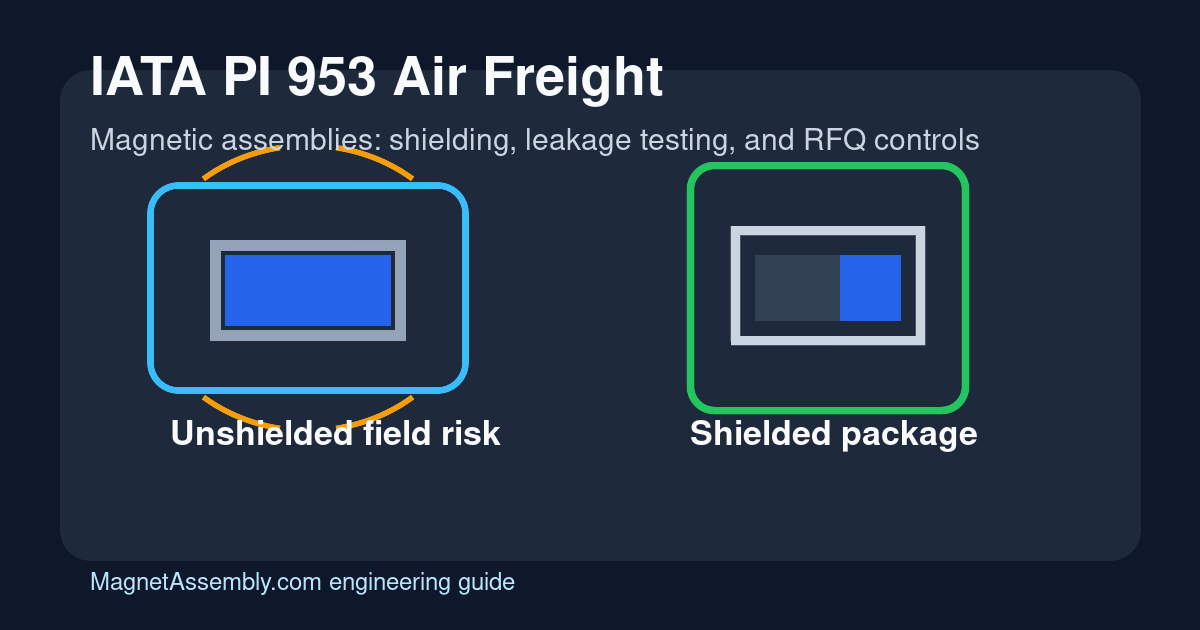
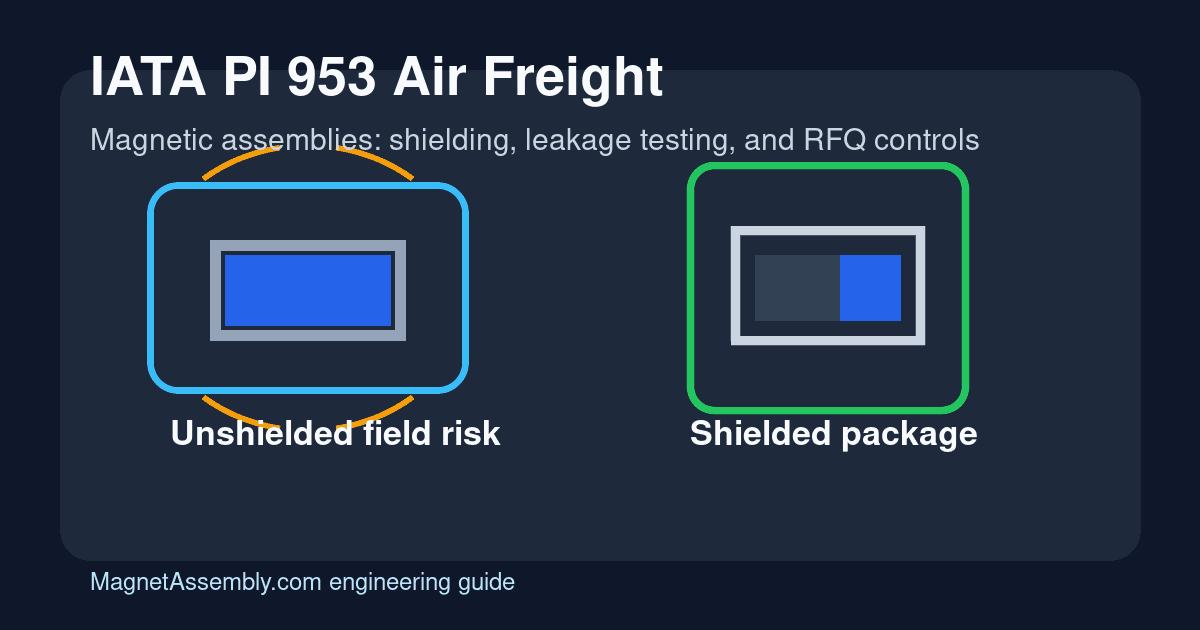
For global procurement teams and OEM engineers, finalizing the design and manufacturing of a high-performance custom magnetic assembly is only half the battle. The second half—often overlooked until the products are sitting on a loading dock—is logistics. Moving powerful Neodymium (NdFeB) or Samarium Cobalt (SmCo) assemblies across international borders via air freight introduces a unique and critical challenge: stray magnetic fields.
If an aircraft’s compass systems or sensitive avionics are exposed to strong magnetic fields, the results can be catastrophic. To prevent this, the International Air Transport Association (IATA) strictly regulates the transportation of magnetized materials under Packing Instruction (PI) 953.
Failure to comply with IATA PI 953 will result in your shipment being rejected at the airport, delayed in customs, or classified as Class 9 Dangerous Goods (UN 2807), which carries massive freight surcharges. This guide provides a deep dive into the engineering, packaging, and procurement strategies required to legally and cost-effectively ship magnetic assemblies by air.
Published for global OEM sourcing and engineering teams on 2026-07-17. Scope: packaged magnetic assemblies moving by air under IATA PI 953, especially NdFeB and SmCo assemblies with measurable stray fields. Limits: this guide is not legal advice, does not replace the current IATA DGR, carrier acceptance rules, or a calibrated leakage test on the packed shipment.
Need a shipment-ready RFQ package before booking air freight? Start with our custom magnetic assembly RFQ checklist and then send drawings, package dimensions, magnet grade, and required delivery window to our engineering team.
1. The Hidden Risk of Air Freight for Magnets
When sourcing magnetic assemblies globally, the default assumption is that standard commercial terms like DAP (Delivered at Place) or DDP (Delivered Duty Paid) cover all logistical headaches. However, powerful permanent magnets emit invisible flux lines that penetrate standard cardboard, wood, and aluminum packaging.
Unlike a battery that is chemically active, a permanent magnet is constantly emitting a field. When loaded into the cargo hold of a commercial or freight aircraft, these flux lines can reach the aircraft's critical navigation instruments. The magnetic interference can deviate compass readings and disrupt fly-by-wire sensor networks.
Because of this risk, airlines and freight forwarders use sensitive Gauss meters to scan packages before they are loaded. If the packaging has not been properly engineered to contain the magnetic field, the shipment is grounded. For an OEM waiting on critical sensor assemblies or motor rotors to keep an assembly line running, a grounded shipment translates to thousands of dollars in downtime.
2. Understanding IATA PI 953 and Magnetic Interference
The IATA Dangerous Goods Regulations (DGR) govern what can and cannot be safely transported by air. Packing Instruction 953 (PI 953) is specifically dedicated to "Magnetized Material."
The core principle of PI 953 is distance-based measurement. The regulation is not concerned with the internal strength of your magnet (e.g., whether it is an N52 or an N35 grade), nor is it concerned with the internal surface gauss. It is exclusively concerned with the stray magnetic field that escapes the outer packaging of your shipment.
To determine if a package is safe for flight, inspectors measure the magnetic field strength at specific distances from any point on the outside of the package. If the field strength drops below the natural background noise of the Earth's magnetic field at that distance, the package is deemed safe.
3. The 4.6 Meter and 2.1 Meter Rules Explained
The PI 953 standard establishes two critical distances and associated thresholds. Understanding these thresholds is vital for determining whether your shipment requires dangerous goods declarations.
The 4.6 Meter (15 Foot) Threshold
This is the primary regulatory boundary. A package must be tested at a distance of 4.6 meters (15 feet) from its outer surface.
- If the field strength is LESS than 0.00525 Gauss (0.418 A/m) or produces a magnetic compass deflection of less than 2 degrees: The shipment is considered Not Restricted and is not subject to dangerous goods regulations.
- If the field strength is GREATER than 0.00525 Gauss: The shipment is classified as Magnetized Material, Class 9 Dangerous Goods (UN 2807). It must bear the specific Class 9 Magnetized Material label, and a Shipper’s Declaration for Dangerous Goods must be provided. Many passenger airlines will refuse UN 2807 cargo entirely, limiting your options to dedicated cargo planes.
The 2.1 Meter (7 Foot) Threshold
While the 4.6-meter rule dictates the legal classification, many airlines and advanced testing facilities utilize a stricter 2.1-meter (7-foot) test to completely bypass any scrutiny.
- If the field strength is LESS than 0.002 Gauss (0.159 A/m) at 2.1 meters: The material is generally considered entirely non-magnetic for transport purposes. Passing this stricter test ensures that even highly sensitive airline cargo scanners will not flag the package, facilitating the fastest possible customs clearance.
4. The Physics of Magnetic Leakage in Air Freight
To solve the shipping problem, engineers must understand magnetic reluctance. Magnetic flux lines, much like electrical current, seek the path of least resistance (lowest reluctance). Air has a relative magnetic permeability ($\mu_r$) of roughly 1, meaning it offers high reluctance to magnetic flux.
When a magnet is placed in a cardboard box, the flux lines travel through the air, extending far beyond the box walls before returning to the opposite pole. To contain these lines, we must introduce a material with high magnetic permeability (low reluctance) around the magnet. This material acts as a "short circuit" for the magnetic field, gathering the flux lines and routing them within the material itself, preventing them from escaping into the surrounding environment.
5. Engineering the Packaging: 3 Methods for Magnetic Shielding
If your initial design fails the 4.6-meter test, you must engineer the packaging to reduce the stray field. There are three primary methods used by professional magnet manufacturers.
If the package uses keeper bars or steel return paths, align the temporary shipping fixture with the permanent magnetic circuit assumptions in your magnetic circuit DFM review, so the logistics fix does not create handling damage or assembly rework at receiving.
Method 1: High-Permeability Shielding (The "Steel Box" Approach)
This is the most common brute-force method. The magnets are placed inside a standard box, and the interior of the box is lined with sheet metal—typically low-carbon steel or specialized soft iron alloys. Because steel has a high magnetic permeability, it absorbs the flux lines and keeps them contained within the shipping carton.
- Pros: Highly effective; requires no changes to the magnet design.
- Cons: Steel is heavy. Lining every box with steel plates drastically increases the volumetric and actual weight of the shipment, sending air freight costs skyrocketing.
Method 2: Flux-Canceling Arrangements
If you are shipping hundreds of small magnetic assemblies, how you arrange them inside the box matters immensely. By stacking the assemblies so that the North pole of one faces the South pole of another, the localized magnetic fields cancel each other out. This multi-pole arrangement minimizes the macroscopic field emitted by the bulk package.
- Pros: Adds zero weight to the shipment; highly cost-effective.
- Cons: Requires careful manual packing or custom vacuum-formed trays; only works for bulk shipments of smaller magnets, not for large, single-unit assemblies like massive motor rotors.
Method 3: Keeper Bars and Closed Circuits
For large magnetic assemblies, engineers can design temporary "keeper bars." A keeper is a piece of soft iron that is temporarily bolted or clamped across the exposed poles of the magnet during transit. This effectively creates a closed magnetic circuit, ensuring nearly 100% of the flux travels through the iron rather than escaping into the air.
- Pros: Incredibly effective for large, high-power assemblies; much lighter than lining an entire box with steel.
- Cons: Requires upfront engineering and custom tooling to create the keeper bars; the end-user must carefully remove the keepers before installation.
6. The True Cost of Shielding: Weight vs. Freight Trade-offs
A critical blind spot for procurement teams is failing to account for the weight of magnetic shielding in the initial Landed Cost analysis.
Consider a standard shipment of Neodymium block magnets that weighs 100 kg. If unshielded, the freight might cost $500. However, if the field is too strong, the factory must line the shipping crates with 2mm thick steel plates. This steel lining can easily add 40 kg to the total shipment weight. At typical air freight rates, that extra 40 kg translates to hundreds of dollars in hidden costs.
When evaluating supplier quotes, you must ask: "Does your quoted FOB/EXW weight include the necessary steel shielding required to pass IATA PI 953?" If a supplier quotes only the net weight of the magnets, your final air freight bill will be a nasty surprise.
7. IATA PI 953 Magnetic Field Thresholds and Actions
To simplify the compliance matrix, use this structured reference table to understand exactly what action is required based on your assembly's stray field.
| Distance | Field Strength (Gauss) | Field Strength (A/m) | IATA Classification | Action Required | Cost / Logistics Impact |
|---|---|---|---|---|---|
| 4.6 m (15 ft) | < 0.00525 | < 0.418 | Not Restricted | Standard shipping; attach test report. | Lowest |
| 2.1 m (7 ft) | < 0.002 | < 0.159 | Not Restricted (Strict) | Standard shipping; bypasses deep inspection. | Lowest |
| 4.6 m (15 ft) | > 0.00525 | > 0.418 | Class 9 Dangerous (UN 2807) | UN 2807 Labeling, DGR Declaration required. | High (Surcharges, restricted airlines) |
| Aircraft Compass | > 2 degrees deflection | N/A | Class 9 Dangerous | Mandatory shielding or DGR declaration. | High |
| Internal Packaging | High | High | N/A | Implement Keeper Bars or flux-canceling. | Moderate (Tooling/Labor) |
| External Shielding | Low | Low | Not Restricted (if shielded properly) | Add steel plate lining to shipping carton. | High (Added freight weight) |
8. The Role of the Supplier's Test Report and Certification
Airlines will not simply take your word that your box of magnets is safe. They require proof.
Before the shipment leaves the factory, your magnet supplier must conduct a formal magnetic leakage test using a calibrated Gauss meter. The result is documented in a Declaration of Compliance or a Magnetic Inspection Report. This document states the exact readings at 2.1 meters and 4.6 meters, certifying that the package falls under the "Not Restricted" limit.
This document must be attached physically to the outside of the shipment and provided digitally to the freight forwarder. Without this report, the airline's ground crew will either refuse the cargo or quarantine it until a third-party testing agency can be hired at the airport—resulting in massive delays and fees.
Treat the leakage report as part of the shipment quality record. It should sit beside drawing revision, packaging revision, inspection date, Gauss meter calibration status, and release owner in your magnetic assembly quality control plan.
9. Sea Freight vs. Air Freight for High-Power Assemblies
If you are manufacturing massive magnetic assemblies—such as 500 kg magnetic separators for mining or gigantic MRI components—achieving PI 953 compliance for air freight may be physically impossible or economically unviable due to the sheer amount of steel shielding required.
In these extreme cases, Sea Freight (Ocean Freight) may be the only viable option. The aircraft-specific PI 953 compass-interference issue does not transfer directly to ocean freight, but the shipper should still confirm carrier, port, and destination documentation requirements before assuming the shipment is unrestricted.
However, sea freight introduces a new risk: corrosion. The salty, humid environment of ocean transit is the worst enemy of NdFeB magnets. If you shift from air to sea freight to bypass PI 953, you must dramatically upgrade your vacuum-sealed moisture-barrier packaging and include industrial desiccants to prevent the assemblies from rusting during the 30-day voyage.
10. Air Freight Procurement Checklist for Magnetic Assemblies
Before approving the final purchase order for an international magnetic assembly shipment, use this checklist to ensure seamless logistics:
- Request the Test Report: Have we mandated an official magnetic field test report (Declaration of Compliance) from the supplier prior to shipment?
- Verify Keeper Bars: Does the assembly design include keeper bars to close the magnetic circuit prior to packing?
- Optimize Packing Arrangements: Is the supplier utilizing alternating polarity packing (flux-canceling) for bulk smaller assemblies?
- Account for Shielding Weight: If shielding is required, have we factored the added steel weight into the DDP/DAP air freight cost estimates?
- Freight Forwarder Alignment: Has our freight forwarder confirmed they accept UN 2807 shipments, in the event that shielding is insufficient?
- Labeling Compliance: Is the packing slip and commercial invoice clearly marked with "Not Restricted per IATA PI 953" if the 4.6m test passes?
11. Frequently Asked Questions (FAQ)
What happens if a shipment fails PI 953 testing at the airport?
The shipment will be grounded immediately. You will be forced to either pay a third-party specialized repacking company at the airport to add steel shielding, or you must arrange to have the cargo returned to the factory for repacking. Both options are expensive and cause weeks of delay.
Do sea freight shipments require the same PI 953 compliance?
No. PI 953 is an IATA (air transport) regulation. Sea freight is governed by the IMDG Code, which generally does not restrict magnetized materials. However, proper moisture-barrier packaging is critical for ocean transit.
Can we use standard aluminum foil or copper mesh to shield the magnetic field?
No. Aluminum and copper are non-ferrous and have a relative magnetic permeability of ~1. They are completely transparent to magnetic flux lines. You must use ferrous materials like low-carbon steel, iron, or specialized mu-metal for effective magnetic shielding.
Does the magnetic shielding affect the performance of the magnet upon arrival?
No. Magnetic shielding merely redirects the flux lines temporarily. Once the steel shielding or keeper bars are removed by the end-user, the magnet's field will return to its normal, fully designed state.
12. Sources & References
- IATA Dangerous Goods Regulations (DGR)
- The Compliance Center: How to Ship Magnets by Air
- FAA PackSafe: Strong Magnets
Shipping custom magnetic assemblies globally shouldn't involve crossing your fingers at customs. Proper Design for Manufacturability (DFM) includes designing for logistics.
If you are dealing with surprise freight surcharges, rejected shipments, or poorly engineered packaging, our team can help. Contact our engineering and logistics specialists or email [email protected] for a free review of your packaging strategy before the shipment is booked.