This page is the engineering version for design, manufacturing, and SQE teams.
For buyer-side RFQ framing first, start here: Magnetic Circuit Design Basics for OEM Buyers.
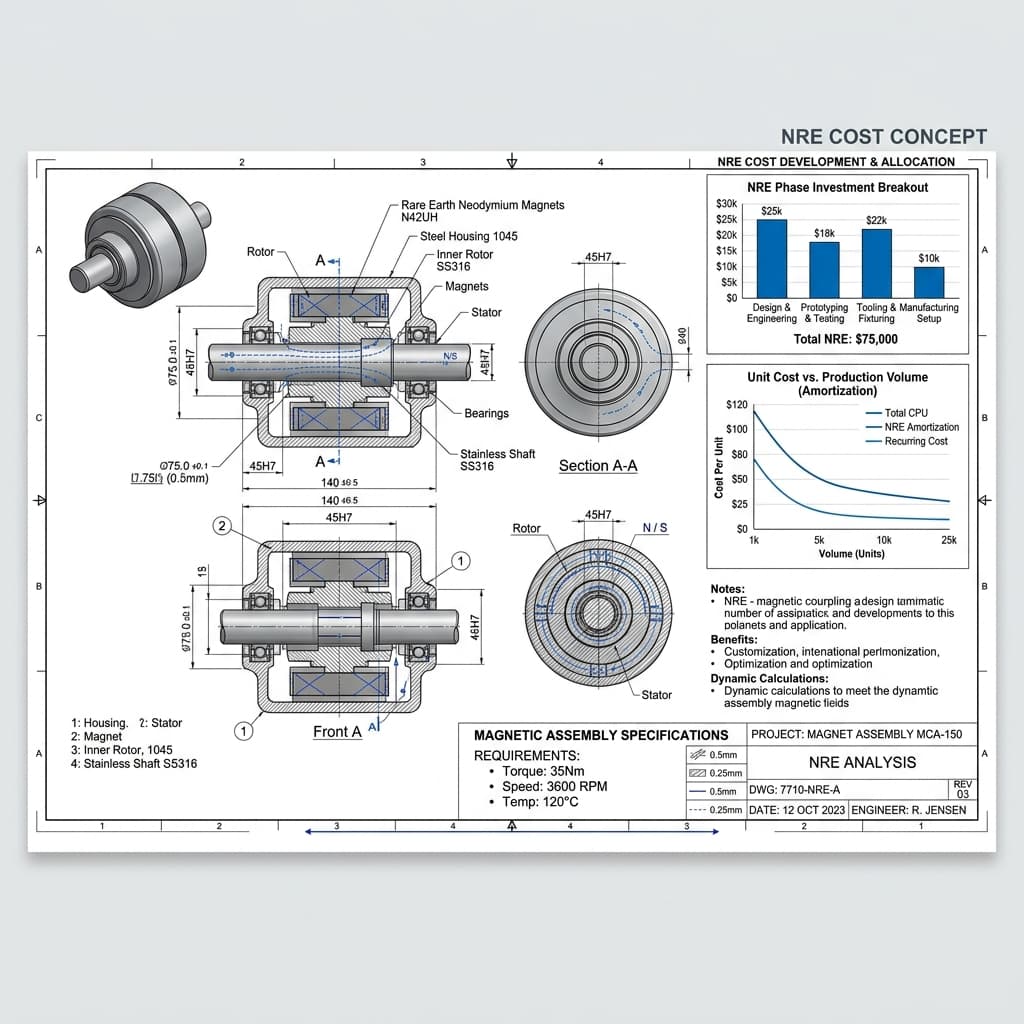
1. Start DFM from magnetic circuit topology
DFM decisions are different for each topology:
- open path: easier structure, higher leakage sensitivity
- semi-closed path: balanced manufacturability and concentration
- closed path: strong field concentration, tighter fit-up control
Pick topology before finalizing tolerance strategy. If topology changes late, fixture and validation plans usually need rework.
2. Return-path design controls
Return-path geometry often determines whether you can meet output with lower magnet grade.
Define these items in design freeze package:
- material family and minimum local thickness
- critical corners where saturation risk is highest
- mating contact quality between magnet and steel path
- coating or surface treatment that may affect interface behavior
Engineering check to run before pilot:
- confirm expected operating point does not drive local return-path bottlenecks
- correlate simulated and measured performance at representative gap condition
If this step is skipped, teams often overcompensate with higher magnet grade and still miss consistency targets.
3. Air-gap sensitivity and datum strategy
Air gap is usually the highest-sensitivity variable in magnetic assemblies.
Practical observation in many programs: a 0.1 mm shift in effective gap can create material output change depending on circuit geometry and target point.
Design rules:
- map all features that contribute to effective air gap
- define one datum chain for magnetic-critical stack only
- avoid mixing functional and cosmetic datums in one control loop
Use a dedicated "magnetic-critical stack" section in drawings so manufacturing knows where tolerance spend matters.
4. Tolerance allocation: where to tighten and where to relax
Do not push extreme precision into brittle magnet components unless functionally required.
A practical allocation approach:
| Feature family | Recommended control strategy |
|---|---|
| Magnet piece tolerance | keep manufacturable, avoid unnecessary ultra-tight grind specs |
| Housing/interface features | use tighter control where they govern effective gap/alignment |
| Assembly-level output | validate through functional measurement, not dimensions only |
This reduces scrap and NRE pressure while protecting functional output.
5. DFM links to retention method
Magnetic circuit design and retention method must be reviewed together.
If using adhesive:
- reserve gap for bond line
- prevent adhesive starvation at insertion
- include cure profile and bond coverage verification
If using press-fit/sleeve:
- control interference and insertion-force window
- protect brittle magnet edges during assembly
- verify runout and post-assembly stress impact
Related engineering detail: Adhesive Bonding vs Press-Fit: Engineering DFM Playbook.
6. Validation matrix from EVT to pilot
| Stage | Purpose | Minimum evidence |
|---|---|---|
| EVT | prove architecture and measurement method | output target reached on defined fixture; top failure modes identified |
| DVT | prove robustness across stress profile | no catastrophic failure in defined stress tests; drift within agreed window |
| PVT | prove process repeatability | critical process controls locked; pilot trend stable; release criteria signed |
Always define sample-size logic and pass/fail boundaries before testing starts.
7. Typical DFM miss and correction
Observed project pattern:
- model predicted output with ideal return-path contact
- production parts had slight interface mismatch and coating variation
- measured output dropped below lower tolerance band in pilot lots
Correction path:
- rework interface control features in housing
- tighten magnetic-critical datum chain only
- add interface quality checkpoint in in-process control
This recovered output consistency without upgrading magnet grade.
8. Engineering handoff packet before release
Before handing design to volume sourcing, prepare:
- topology and return-path assumptions
- magnetic-critical datum chain and tolerance logic
- functional validation matrix with pass/fail lines
- retention-method control plan
- change triggers that require revalidation
This packet prevents interpretation drift across design, manufacturing, and supplier teams.
9. Workflow links
- Buyer-side framing: Magnetic Circuit Design Basics for OEM Buyers
- RFQ structure: How to Specify a Custom Magnetic Assembly in Your RFQ
- Pilot transfer controls: Prototype to Production Guide for Magnetic Assemblies
10. Advanced Deep Dive: Saturation in the Return Path (Steel Bottlenecks)
Engineers frequently upgrade to a higher grade of NdFeB (e.g., N52) expecting a proportional increase in pull force or flux, only to see zero improvement. The culprit is almost always magnetic saturation in the steel return path.
Case Study: Heavy-Duty Holding Magnet
- The Issue: A customer upgraded a holding magnet from N35 to N52 to achieve a 20% increase in holding force. The measured force only increased by 2%.
- The Analysis: FEA (Finite Element Analysis) showed that the SPCC steel cup was fully saturated at 1.8 Tesla. The extra flux generated by the N52 magnet had nowhere to travel and simply leaked into the surrounding air.
- The DFM Solution: We downgraded the magnet back to N35 (saving 30% on magnet cost) and increased the wall thickness of the steel cup by 1.5mm. This eliminated the saturation bottleneck, and the holding force increased by 25%.
- Takeaway: The return path governs the maximum output. Don't pay for N52 if your steel is already choking on N35.
For engineering DFM review of your circuit stack and validation plan, contact [email protected] or WhatsApp +8618857971991 (Open WhatsApp).